

 Animals
 Food & Drink
 Nature
 Arts & Culture
 Music
Music
 Countries of the world
 Activities & Leisure
 Romantic
 Geometrics
 Humorous
 Famous Painters
 The Little Prince
 Mismatched
 Matched
 Valentine's Day
 Mother's Day
 Father's Day
 Halloween
 Christmas
 Retour à l'école
 Easter
 Secret Santa



Socks have been around since the Stone Age, long before the concept of pants or t-shirts existed. Until recently neglected, socks are today an integral part of clothing and the market offers a wide range of original, stylish and even fun models.
But did you know that socks were not always so easy to find and that for a long time they were only worn by the nobility?
The beginnings
Dating back to the Stone Age, ca. 5000 BC, the first "socks" worn by our ancestors had little in common with current models. According to cave paintings and archaeological finds, these crude socks were made of animal skins tied around the ankle.
We fast forward to the 8th century BC, when socks were first mentioned in writing by the Greek poet Hesiod. In one poem, Hesiod mentions a type of felted animal hair socks worn under sandals.
Later Romans wrapped their legs in straps of leather or cloth. Around the 2nd century AD, they began sewing together pieces of fabric and making fitted socks – the first to resemble what we wear today.
The first woolen socks were found in Northumbria (northern England) and date back to the 2nd century AD. These are children's sizes, made from wool fabric, designed to keep feet warm in cold weather.
It was also at this time that the first knitted socks appeared in Egypt. The oldest known pair of knitted socks, made with a special technique called nalebinding , dates from 300 to 500 A.D. The socks have toes so they can be worn with sandals.
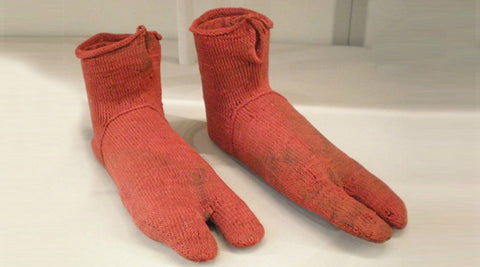
Nalebinding socks (Egypt, 300-500 AD)
The sock, a luxury
In the Middle Ages, the length of the pants was lengthened, and the sock turned into a thick, brightly colored fabric, covering the lower leg. Since the socks did not have elastic, garters were placed on the upper part to prevent them from falling off. By the year 1000, knitted and woven socks had become a symbol of nobility throughout much of Europe.
Nobles' socks were usually made of high-quality fabric, with a back seam and cut. In the 15th century, French and Italian aristocracies became known for their fine hand-knitted silk socks. Men have discovered that stretch silk fabric has two benefits: ease of movement and the ability to slim the legs.
In 1589, William Lee, an English clergyman, invented the first stocking knitting machine. Even after receiving a pair of black socks from the pastor, Queen Elizabeth I ultimately refused to grant him a patent for his invention. She complained that her machine had made woolen socks that were too rough for the king's ankles. But it is likely that the Queen was more concerned about the many hand knitters in the kingdom whose livelihoods could be threatened by such mechanization.
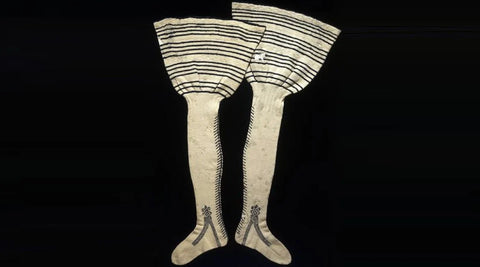
Mid-16th century knee-highs
However, King Henry IV saw the opportunity offered by William's invention and offered him financial support. The inventor settled in Rouen, where he built an animal breeding factory. After him, the French spread the loom throughout Europe. Socks for common people were made of wool, while for nobles colored silk was used. After the Industrial Revolution, socks became easier and cheaper to make, spreading their appeal and practicality throughout European society.
Modern times
Over the following years, sock fashion continued to evolve, as did the length of the models. Instead of sticking to the main components, sock fashion is expanding and including even more colors, decorations or stripes. In the late 17th century, cotton became a popular choice for many garments and accessories, including socks.
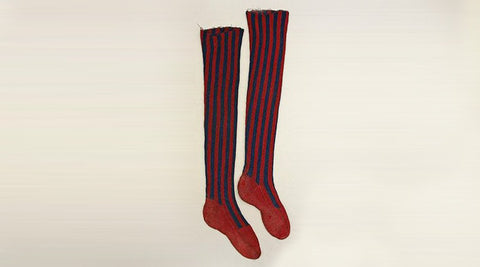
19th century striped knee-highs
The next revolution in sock production came with the invention of nylon in 1938. The strength and elasticity of socks made from cotton and nylon blends led to a natural advancement in production. This mixture is still used today. Elastane was then added to the composition to provide additional flexibility to the socks and to be worn by a wider range of users.
Regarding styles, nowadays you can find a variety of models, colorful, original and fun socks.
Socks not only protect and warm our feet, they reflect each person's style, individuality and preferences.

